
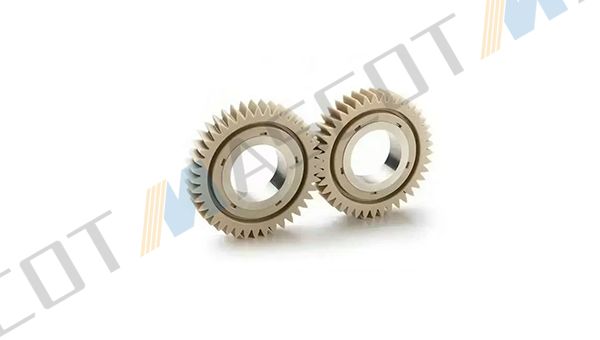
PEEK gears are high-performance transmission components made of polyetheretherketone (PEEK) as the substrate through injection molding, compression molding, or machining. With characteristics such as lightweight, extreme environmental resistance, and self-lubricating, they are replacing traditional metal gears as the core components in the high-end manufacturing field. The following is a detailed description:
1、 Core material characteristics and performance advantages
Breakthrough in basic performance
High temperature resistance: Long term working temperature -200 ℃~260 ℃, short-term can reach 310 ℃, far exceeding ordinary engineering plastics (such as POM<200 ℃), meeting the requirements of high temperature working conditions.
High strength and lightweight: Pure PEEK has a tensile strength of over 100MPa (close to aluminum alloy) and a density of only 1.32g/cm ³ (1/5 of steel). After carbon fiber reinforcement (CF30), the tensile strength reaches 230MPa, reducing weight by more than 60% while maintaining rigidity.
Self lubrication: The dry friction coefficient is 0.3~0.4, which decreases to 0.02 after adding molybdenum disulfide. It can operate without lubricating oil, avoiding oil pollution and reducing maintenance costs.
Corrosion resistance: Resistant to organic solvents such as 98% concentrated sulfuric acid, 50% sodium hydroxide, and toluene. Its lifespan is more than three times that of metal gears in corrosive environments such as chemical and medical industries.
Differentiated design of filling system
CF30 (30% carbon fiber): rigidity increased by 40%, thermal conductivity increased by 3.5 times, suitable for high temperature and high pressure scenarios (such as LNG storage tank valve gears).
GF30 (30% glass fiber): With a 30% increase in dimensional stability and excellent creep resistance, it is used for long-term static sealing of gears (such as control rod drive mechanisms in nuclear reactors).
MOD (carbon fiber+PTFE+graphite): increased wear resistance by 5 times, suitable for high-frequency opening and closing of chemical reaction kettle switch valves.
2、 Typical application scenarios and industry solutions
In the field of automobiles and new energy
Fuel powered vehicles: replacing metal gears for water pumps, fuel pumps, seat adjusters, etc., reducing weight by 70%, noise by 50%, resistant to automotive oil corrosion, with a lifespan of over 100000 kilometers.
New energy vehicles: After adopting PEEK for the reduction gear of a certain pure electric vehicle, the weight of a single system is reduced by 3.8kg, the range is increased by 20-25km, the power response time is shortened by 50%, and the power consumption per hundred kilometers is reduced by 8% -10%.
Aerospace and Military Industry
Drone transmission system: resistant to alternating temperatures ranging from -50 ℃ to 200 ℃, leak free under high-frequency reciprocating motion, MTBF exceeding 8000 hours, and can replace metal parts to reduce weight by 60%.
Satellite attitude control mechanism: resistant to -196 ℃ liquid oxygen environment and vacuum leakage rate<1 × 10 ⁻⁹ Pa · m ³/s, ensuring orbit adjustment accuracy.
Medical and Precision Instruments
surgical robot
ivds
Semiconductor and Electronic Manufacturing
Wafer processing equipment: ultra-high vacuum (leakage rate<1 × 10 ⁻¹⁰ Pa · m ³/s), plasma corrosion resistance, ensuring 7nm process wafer yield.
SMT reflow soldering furnace: capable of withstanding a soldering temperature of 260 ℃, preventing solder splatter from contaminating the workshop, with a temperature control accuracy of ± 2 ℃.