
In precision machinery and industrial components, the wave spring is an elastic element that appears simple yet is incredibly powerful. With its unique wave-like structure, it can generate radial force or outward pressure when axially compressed, making it an indispensable part of many high-precision applications.
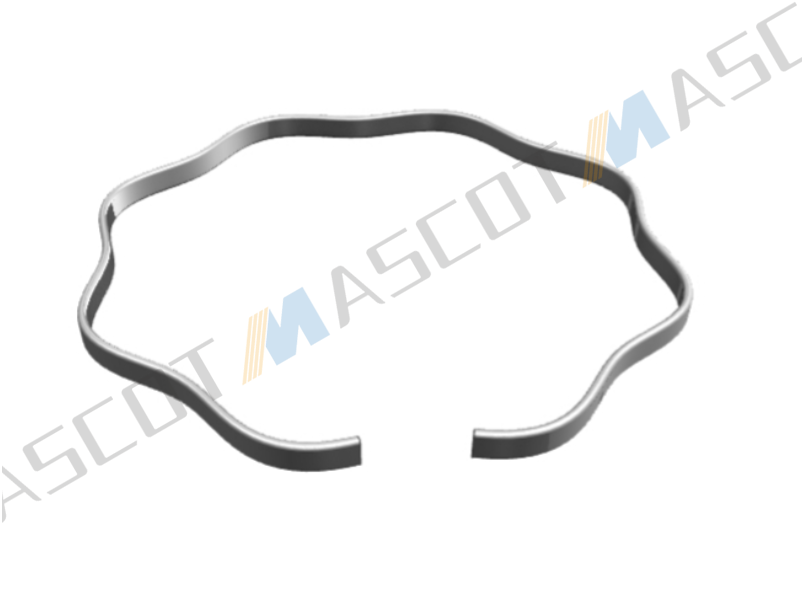
What is a Wave Spring?
A wave spring is a ring-shaped spring made from precision-processed metal strips, featuring a continuous wave-like surface. When subjected to axial compression, the wave spring undergoes elastic deformation, not only storing energy but also applying a uniform force in the radial direction. This design allows it to provide elasticity comparable to traditional coil springs while occupying a smaller installation volume.
Core Function: Radial Force and Self-Adjustment
The core advantage of the wave spring lies in its ability to deliver controllable radial force. For example:
Compensating for Tolerances: During assembly, dimensional differences between parts are inevitable. The wave spring can automatically fill gaps, compensate for tolerances, and ensure tight connections between components.
Self-Centering Positioning: In applications requiring precise alignment (such as bearing housings or sensor installations), the radial force of the wave spring can push parts to automatically center themselves, enhancing system stability.
Activating Seals: When external pressure sources are unavailable, the wave spring can serve as a preload element, squeezing seals (e.g., O-rings) to ensure reliable sealing performance.
Application Scenarios
Wave springs are widely used in aerospace, automotive manufacturing, medical devices, and precision instruments. For instance:
Preloading valve seats in valves to prevent media leakage;
Providing constant friction in robotic joints to ensure motion accuracy;
Compensating for dimensional changes caused by thermal expansion in microelectronic devices.
Why Choose Wave Springs?
Compared to traditional springs, wave springs occupy less space, are lighter in weight, and offer controllable linear force curves. Their compact design is particularly suited to the trend of miniaturization and lightweighting in modern equipment. Additionally, through material selection (e.g., stainless steel, chromium alloys) and surface treatments (e.g., zinc plating, passivation), they can adapt to harsh environments such as high temperatures and corrosion.
Conclusion
Though small, the wave spring is a classic example of "small but mighty" in industrial design. With its intelligent mechanical properties, it quietly supports the reliable operation of countless precision systems. In the future, as manufacturing processes advance, wave springs will play a key role in even more innovative fields.
As a professional brand in the field of wave springs, Mascot deeply focuses on process and material innovation. Its products not only precisely match the aforementioned application scenarios but can also be customized for force values, dimensions, and weather resistance according to equipment requirements. This ensures the stable operation of precision systems from the source, allowing the big wisdom of "small parts" to be truly implemented in every device.