
I. Mechanical Stress: The Most Direct Physical Damage
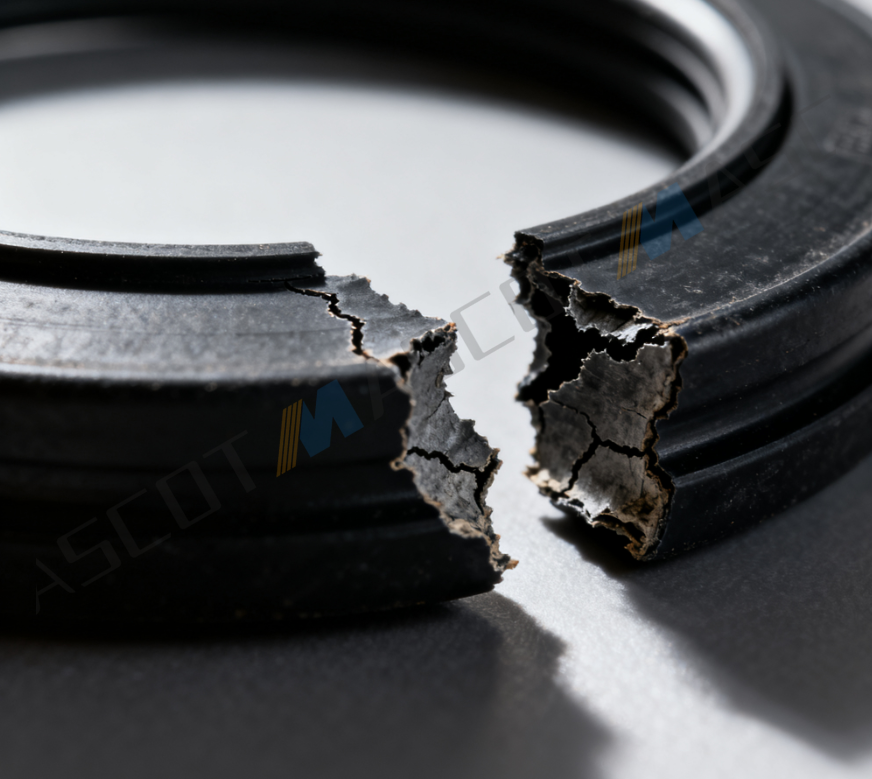
Mechanical factors are the most common cause of seal failure. Firstly, improper compression: Over-tight installation exerts excessive stress on the seal, accelerating permanent deformation and frictional heat generation, which leads to premature wear or tearing. On the other hand, insufficient compression fails to form an effective seal, potentially causing fretting wear and leakage. Secondly, surface roughness: An overly rough mating surface acts like a file, causing severe abrasive wear; however, an excessively smooth surface makes it difficult to form a lubricating film, easily triggering dry friction. Thirdly, gap extrusion: Under high pressure, the seal material can be squeezed into the fitting gap between components. When the pressure is too high or the gap is too large, the edge of the seal is prone to being "bitten off," resulting in permanent tearing. Additionally, contaminants present in the system (such as metal shavings and dust) can embed into the sealing surface, acting as abrasives that continuously scratch the seal.
II. Chemical Corrosion: The Challenge of Material Compatibility
The chemical compatibility between the seal material and the working medium is crucial. Incompatibility can lead to a variety of issues: first, swelling—medium molecules penetrate the rubber network, causing it to expand in volume and decrease in strength; second, corrosive degradation—strong acids, strong alkalis, or ozone damage the polymer molecular chains, making the material brittle and prone to cracking; third, diameter reduction—certain media can extract plasticizers from the seal, causing it to shrink and harden, thus losing its sealing ability.
III. Thermal Effects: The Dual Threat of Temperature
Temperature has a significant impact on rubber performance. High temperatures accelerate material aging, causing it to harden and become brittle, while also intensifying compression set—even after unloading, the material cannot return to its original shape. Extremely high temperatures may even cause rubber carbonization. Conversely, low temperatures drastically reduce rubber elasticity, making the material hard and brittle. This leads to insufficient sealing force, resulting in leakage, and the material is prone to fracture under stress.
IV. Installation and Maintenance: The Impact of Human Factors
Improper installation is one of the main causes of early seal damage. Sharp edges, burrs, or rough handling can easily cause scratches, cuts, or distortion. Insufficient lubrication during installation leads to initial dry friction, generating instant high temperatures and wear. Furthermore, impurities introduced in an unclean installation environment also hidden dangers (pose hidden risks).