
1. What is an O-Ring?
Just as the name suggests, it’s an "O"-shaped rubber ring.
Its biggest advantages are its simple structure, extremely low cost, and wide range of applications. More importantly, it is highly standardized. If it breaks, a replacement is easy to find, making it the "universal currency" of the industrial world.
2. How to Install It Right?
When installed in a groove, an O-ring must be in a "tense" state:
Mounted on a shaft: It should be slightly stretched (about 1% negative tolerance) so it grips the shaft tightly.
Fitted into a bore: It should be slightly compressed to fill the gap.
If it's too loose, it will leak. If it's too tight, it will break easily.
3. Sealing Principle: Locked by Elastic Force
When an O-ring is compressed, it generates a restorative force trying to return to its original shape. This force presses firmly against the contact surface, blocking the fluid's path.
The degree of compression is called the "Compression Ratio" :
Too small: Insufficient force leads to leakage.
Too large: The rubber experiences "overwork death," resulting in permanent compression set. It can no longer return to shape, and leakage will still occur.
Therefore, the compression ratio must be within a reasonable range – it's safest to follow the groove dimensions recommended by the manufacturer.
4. Mascot Tech's "Two Ace Materials"
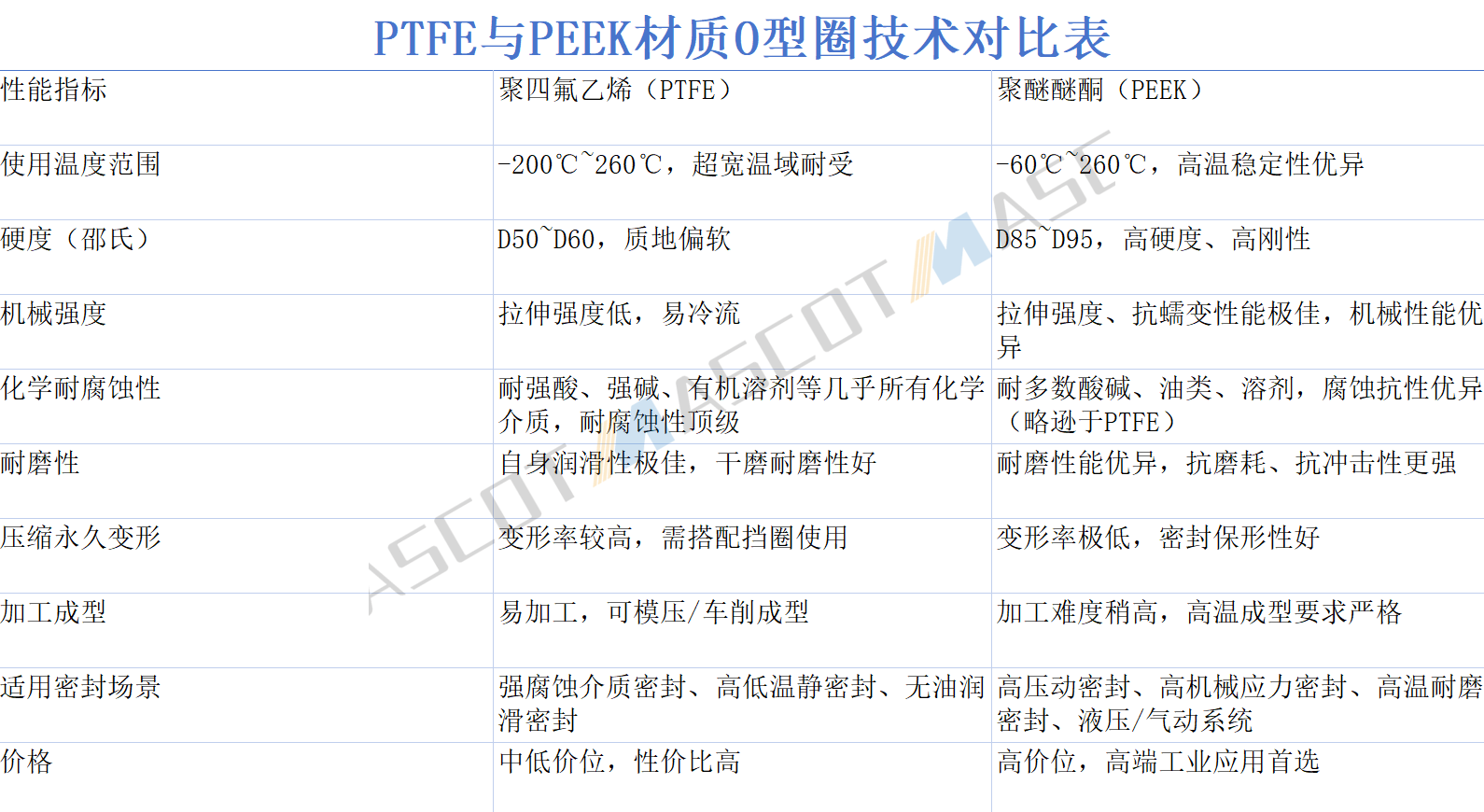
There are many O-ring materials on the market, but Mascot Tech focuses on high-performance materials to tackle various "difficult and complicated cases":
Conclusion
Conclusion
From car engines to spacecraft, from coffee makers to deep-sea detectors, O-rings are everywhere.
What Mascot Tech sells is not just a small sealing ring, but a deep understanding of the rigidity of PEEK and the smoothness of PTFE.
Don't let a small O-ring become a big headache for your equipment.
Mascot Tech – Holding the last line of defense for your fluid system.