1. Material Selection for Torsion Springs
The choice of material is critical, as it directly impacts the performance and service life of the torsion spring. Common materials include:
-
Carbon Steel: Cost-effective with moderate strength and toughness, suitable for general applications with standard performance requirements.
-
Alloy Steel: Offers higher strength and superior elasticity, capable of withstanding greater torque and stress, making it ideal for industrial equipment with demanding performance needs.
-
Stainless Steel: Provides excellent corrosion resistance, making it suitable for humid or corrosive environments, such as food processing equipment and marine engineering.
At Mascot, we offer a wide range of materials, including stainless steel wire, music wire, oil-tempered wire, and chrome silicon steel, ensuring customized solutions for diverse client requirements.
2. Application Scenarios of Torsion Springs
Thanks to their unique torque characteristics and spatial adaptability, torsion springs play a vital role across multiple industries:
-
Automotive Industry: Used in door latch systems, seat adjustment mechanisms, and gearshift assemblies.
-
Industrial Equipment: Found in valve actuators, transmission reset mechanisms, and reciprocating motion components in automated machinery.
-
Household Appliances: Applied in washing machine door locks, oven timer reset systems, and various switch buttons.
-
Medical Devices: Utilized in surgical instrument auto-reset mechanisms, adjustable support positioning systems, and diagnostic equipment drive systems.
Additionally, customized torsion spring solutions demonstrate outstanding performance in electronics, office automation, toy models, and aerospace applications.
3. Installation of Torsion Springs
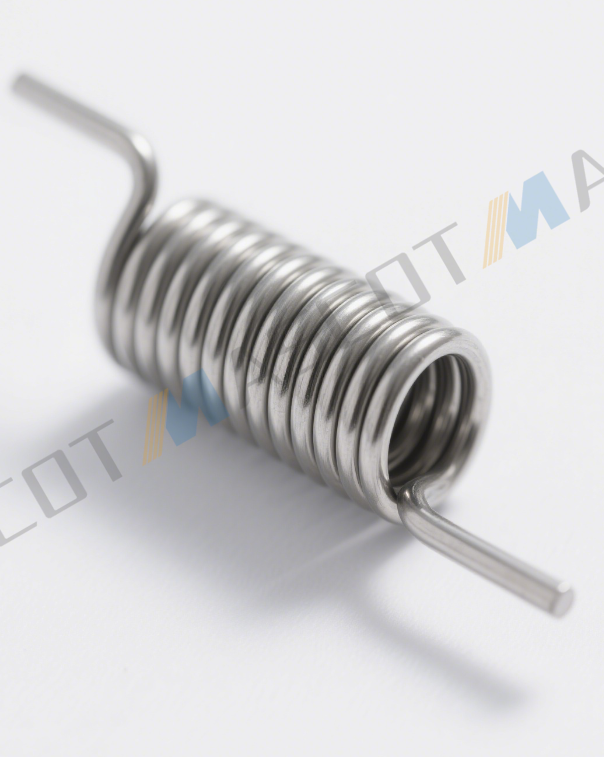
Torsion springs are typically mounted on a mandrel (shaft), often accompanied by an outer cylindrical housing for positioning and protection. However, when the legs are securely fixed, torsion springs can function without a mandrel. The most common leg orientation is tangential to the coil body, though radial or axial leg configurations are also feasible. In many applications, the leg direction and length must be carefully designed to match adjacent assembly components.
By adjusting parameters such as outer diameter, wire diameter, leg angle, and coil count, we provide comprehensive solutions ranging from standard to fully customized torsion springs. Currently, our standard products cover wire diameters from 0.3 mm to 3.43 mm, meeting diverse torque requirements.
If you're struggling with torsion spring selection or material choices, contact Mascot's expert technical team for one-on-one consultation and tailored solutions, ensuring the optimal torsion spring for your specific application.