
For AI computing data centers, major liquid‑cooling operational headaches seldom stem from large‑scale hardware failures. Instead, they come from recurring micro‑leaks, unplanned downtime and frequent rework. Even with premium FKM and EPDM sealing rings deployed, many data centers still suffer cold‑plate seepage, blind‑mate connector leakage and pipeline pressure drop. These issues trigger computing service interruptions and soaring maintenance costs. Most structural engineers fall into the same trap: focusing solely on primary seal selection while overlooking gaskets as a key hazard behind high‑pressure liquid‑cooling seal failure.
AI liquid‑cooling systems operate under harsh conditions: 0.8‑1.6 MPa working pressure, 7×24‑hour continuous runtime and frequent thermal cycling. Conventional PTFE gaskets can hardly meet such demanding requirements. Soft‑textured PTFE gaskets feature poor creep resistance. Under prolonged high‑pressure compression, they deform, relax and suffer dimensional collapse, which opens up gaps in sealing grooves. High‑pressure fluid then tears and compresses rubber sealing rings, causing invisible extrusion cracking. Such hidden defects are hard to detect at an early stage. Over time, they develop into severe leakage, which may burn out servers, shut down data centers and incur heavy financial losses.
This explains why PEEK gaskets outperform PTFE alternatives for high‑pressure AI liquid‑cooling applications and resolve core industry pain points. As a high‑performance engineering plastic, PEEK delivers high rigidity and outstanding creep resistance. It resists plastic deformation under sustained pressure and temperature swings, maintains precise dimensions and seals groove gaps reliably. It fundamentally prevents leakage caused by seal extrusion and suits year‑round non‑stop operation of computing hardware.
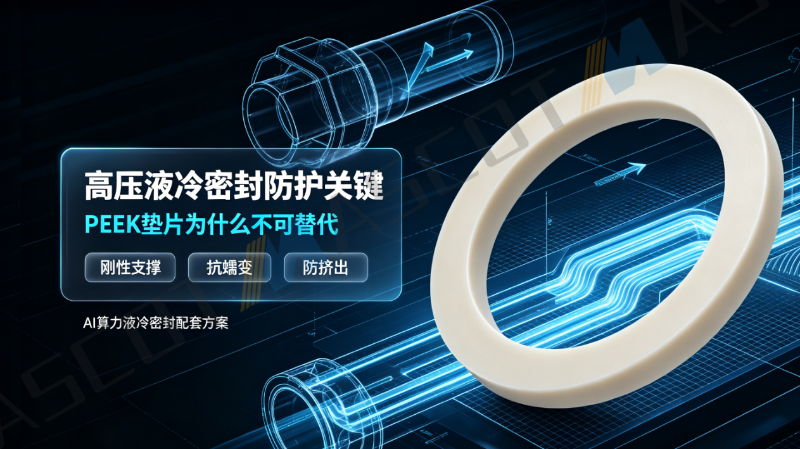
PEEK gaskets also excel in compatibility with liquid‑cooling media. The widely used deionized water‑glycol coolant imposes strict requirements on material leaching and chemical resistance. Ordinary gaskets immersed in coolant tend to leach contaminants, swell and age. They pollute the coolant, clog cold‑plate channels and degrade heat dissipation performance. By contrast, PEEK boasts exceptional chemical stability. It is hydrolysis‑resistant with minimal leaching, non‑corrosive and non‑swelling. It keeps coolant clean, avoids secondary equipment failures and cuts overall maintenance expenditure.
Furthermore, PEEK gaskets feature high wear and tear resistance. They withstand repeated assembly, disassembly and servicing of liquid‑cooling connectors without chipping or damage. Compatible with mainstream rubber sealing assemblies, they ensure high assembly yield and long service life, lowering part replacement and rework labor costs. PTFE gaskets may be adopted for cost control under pressures below 1.0 MPa. Nevertheless, PEEK gaskets represent a must‑have solution for risk mitigation in high‑pressure core computing equipment.
The reliability of liquid‑cooling systems often hinges on auxiliary components rather than primary seals. Mascot specializes in R&D and manufacturing of precision liquid‑cooling components. Our self‑developed high‑quality PEEK gaskets are made of premium raw materials via precision turning. They deliver tight dimensional tolerances, stable creep resistance and low‑leaching properties. Well‑suited for high‑pressure scenarios including GPU cold plates, blind‑mate connectors and CDU pipelines, Mascot supplies both standard and custom‑made parts for diverse AI liquid‑cooling hardware. We help eliminate leakage‑induced downtime risks and safeguard long‑term stable performance of computing infrastructure.