
In hydraulic and pneumatic reciprocating equipment, Y-type and U-type dust seals are core protective components. They block dust, sediment, metal shavings and other contaminants to safeguard precision parts such as piston rods and hydraulic cylinders. Many people assume the two look similar and perform equally, yet they differ drastically in structural principles, dustproof performance and application scenarios. Wrong selection will lead to component abrasion, internal contamination, leakage and equipment stalling, driving up maintenance costs. This article breaks down their key distinctions to help you select the right seal and avoid common mistakes.
1. Structural Differences: Distinct Shapes Bring Different Working Principles
The fundamental performance gap stems from their unique cross-sectional structures.
A Y-type dust seal features a standard Y-shaped profile with symmetrical dual sealing lips and a slim, flexible waist. Thanks to the inherent high elasticity of PU material, it operates as a pressure-adaptive dust seal. Minor fluid pressure or mechanical force during operation pushes its lips to closely cling to piston rod surfaces, delivering outstanding conformability. It maintains gap-free dust sealing even under low pressure and low-speed conditions.

A U-type dust seal has a solid U-shaped cross-section with wider lips and a rounded base, granting its waist far higher rigidity than the Y-type variant. It relies on pre-compression during installation to achieve dustproof contact, boasting superior structural stability and resistance to deformation and extrusion. Unlike Y-type seals, it avoids lip displacement or flipping under sudden pressure surges and heavy loads, though its adaptive surface fitting capability is slightly weaker at low pressure.
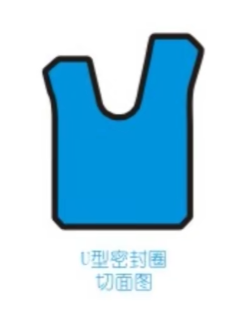
2. Application Scenarios: Tailored Performance for Different Equipment
Structural variances define their dustproof capabilities and ideal working conditions, the primary reference for industrial selection.
With symmetric flexible lips, Y-type dust seals create minimal friction and deliver responsive, balanced bidirectional contact. They are designed for medium-low pressure, high-speed, frequent reciprocating motion. Widely applied to small air cylinders, standard hydraulic cylinders and automated equipment piston rods, they efficiently trap fine dust without compromising equipment precision or response speed. They also tolerate wide temperature fluctuations, making them highly versatile for general working environments.
U-type dust seals benefit from thick lips and a rigid body, offering exceptional anti-extrusion, impact and wear resistance. They are engineered for high-pressure, heavy-load and harsh working conditions, including large hydraulic presses, construction machinery and mining hydraulic systems. Even under intense pressure shocks and constant heavy friction, they retain their shape without lip detachment or failure. Their thick construction withstands abrasion from sand and granular debris, delivering reliable dust protection in outdoor, heavily polluted environments.
3. Installation & Service Life: Different Tolerance Requirements and Durability
The two seal types also have separate installation standards and lifespan characteristics.
Y-type dust seals feature excellent flexibility and generous tolerance for groove dimensional accuracy, making them easy to install. As long as groove clearance stays within a reasonable range, they fit most standard dust seal mounting positions.
U-type dust seals possess stiffer, more rigid structures that demand tighter dimensional tolerances and flat mounting grooves. Installers must maintain standardized pre-compression and prevent sharp edges from scratching the sealing lips. In return, they excel in wear resistance, anti-aging and anti-extrusion performance with a much longer service life, reducing frequent part replacements for equipment running continuously under harsh loads.
4. Selection Guide: Match Seals to Your Actual Working Conditions
Never choose based solely on appearance — align your selection with real operating conditions:
• Pick Y-type dust seals for medium-low pressure, high-speed frequent reciprocation, mild environments and applications requiring precise equipment operation.
• Choose U-type dust seals for high-pressure heavy loads, outdoor dusty sites, media with solid impurities, and systems requiring long-term stable, anti-extrusion dust protection.
Proper selection maximizes dust blocking performance and eliminates equipment contamination and wear at the source.
Reliable Dust Seals: Mascot Dust Seals for All Working Conditions
To eliminate hidden equipment risks caused by mismatched or low-quality seals, premium products are indispensable.
With years of expertise in sealing and dustproof components, Mascot manufactures Y-type and U-type polyurethane dust seals made from high-purity wear-resistant PU raw materials. Precision one-piece molding delivers consistent dimensional accuracy, uniform elasticity and stable structural integrity.
Our Y-type dust seals feature superior conformability, tight contact and low friction without interfering with equipment movement. Our U-type dust seals withstand extreme pressure and abrasion, performing reliably in the harshest environments. Both models fully meet the dust protection demands of all hydraulic and pneumatic machinery.
Every Mascot dust seal undergoes strict quality control, from raw material inspection and precision processing to finished product testing. Balancing precision, stability and long service life, they effectively protect industrial equipment and cut overall failure and maintenance expenses.